The world of haute couture is defined by unparalleled craftsmanship, where a single gown can represent hundreds of hours of manual labor. These garments are not merely clothing; they are significant financial and artistic investments. Because of their intricate nature, they require a level of maintenance that far exceeds the capabilities of a standard neighborhood dry cleaner.
Trust these masterpieces to a couture cleaning atelier to ensure their longevity and structural integrity. At a couture cleaning atelier, the process moves beyond simple stain removal into the realm of textile conservation.
Madame Paulette has served as the premier destination for the world’s most expensive wardrobes. Our reputation is built on a foundation of trust with major fashion houses and private collectors globally. When a garment enters our couture cleaning atelier, it undergoes a transformation guided by master artisans who treat every stitch with reverence.
The Art and Science of Couture Cleaning
The operation of a couture cleaning atelier is a sophisticated blend of chemistry, physics, and manual artistry. Unlike mass-produced apparel, which is designed to withstand standardized cleaning cycles, couture is built for aesthetics first. This means the cleaning process must be customized for every individual piece. There is no “one size fits all” manual in this niche; instead, there is a deep reliance on the experience of veteran technicians who understand the molecular behavior of different fibers.
Why Couture Requires Specialized Cleaning
Couture garments are often constructed from a mix of contrasting materials that react differently to cleaning agents. You might see a bodice made of stiffened silk faille paired with a skirt of ethereal tulle and hand-painted organza. These specialty fabric care requirements are daunting. For instance, silk can lose its natural oils and become brittle if exposed to the wrong solvents, while lace can snag or tear under the slightest mechanical agitation.
Furthermore, many designer pieces feature “non-serviceable” trims, elements like lead crystal beads, heat-sensitive plastics, or organic dyes that run at the first sign of moisture. Standard cleaning methods would lead to destruction. This is why designer garment cleaning is a high-stakes profession.
The Role Of A Couture Cleaning Atelier
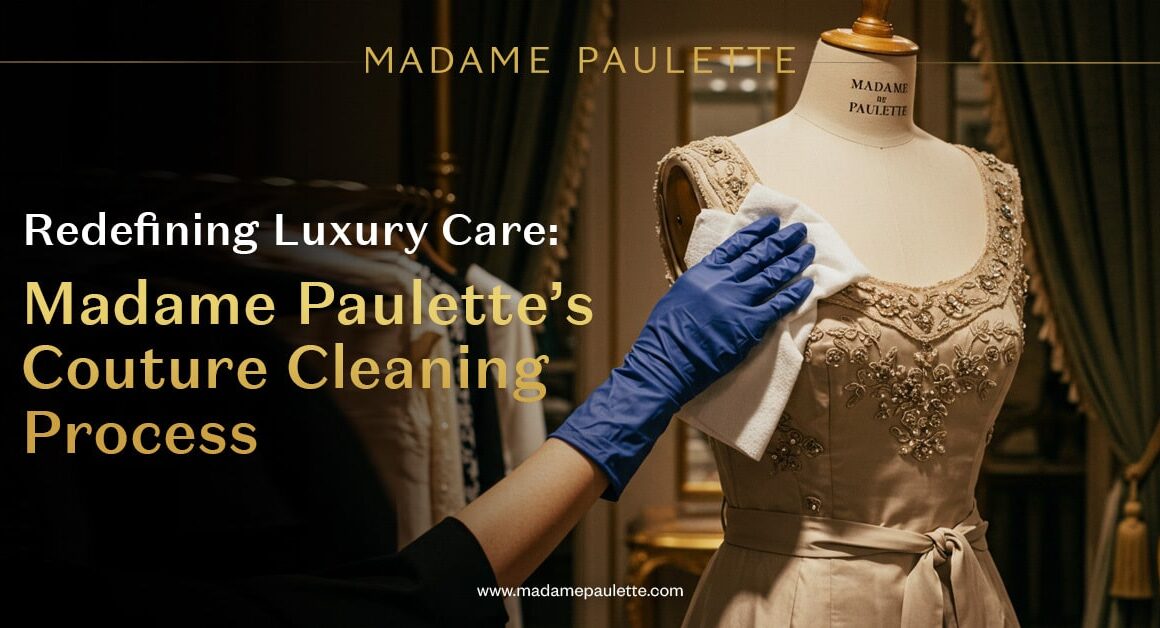
A couture cleaning atelier functions as a high-tech laboratory. It is a space where the air is filtered to prevent dust contamination, and the lighting is calibrated to reveal the faintest discolorations. The role of the atelier is to act as a guardian of fashion history. Inside, you won’t find the steam-filled, chaotic environment of a commercial laundry.
The expertise here extends to luxury clothing care on a global scale. These professionals stay up to date on the latest textile innovations, such as 3D-printed fabrics and metallic-coated fibers, ensuring they can handle even the most futuristic designs. By combining this modern technical knowledge with age-old hand-finishing techniques, the atelier provides a comprehensive service that restores both the look and the feel of the garment.
Step-by-Step: What Happens Behind the Scenes
The workflow inside a couture cleaning atelier is a disciplined, multi-stage journey. Every garment is treated as a unique case study, moving through a series of checkpoints designed to mitigate risk while maximizing results.
Inspection and Assessment
The moment a garment arrives, it undergoes a forensic-level inspection. This is the cornerstone of our premium fabric preservation. Technicians use high-magnification loops to check for weakened threads, loose embellishments, and oxidation. Oxidation is particularly dangerous; it occurs when sugar-based stains (like champagne or soda) dry clear but turn yellow or brown over time as they react with oxygen.
During this phase, the team creates a “map” of the garment. They document every flaw to ensure that the cleaning process does not exacerbate existing damage. This level of couture garment handling allows the atelier to communicate clearly with the client about what can realistically be achieved. If a vintage Dior gown has shattered silk linings, the assessment will highlight the need for structural reinforcement before any cleaning begins.
Fabric Preparation and Pre-Treatment
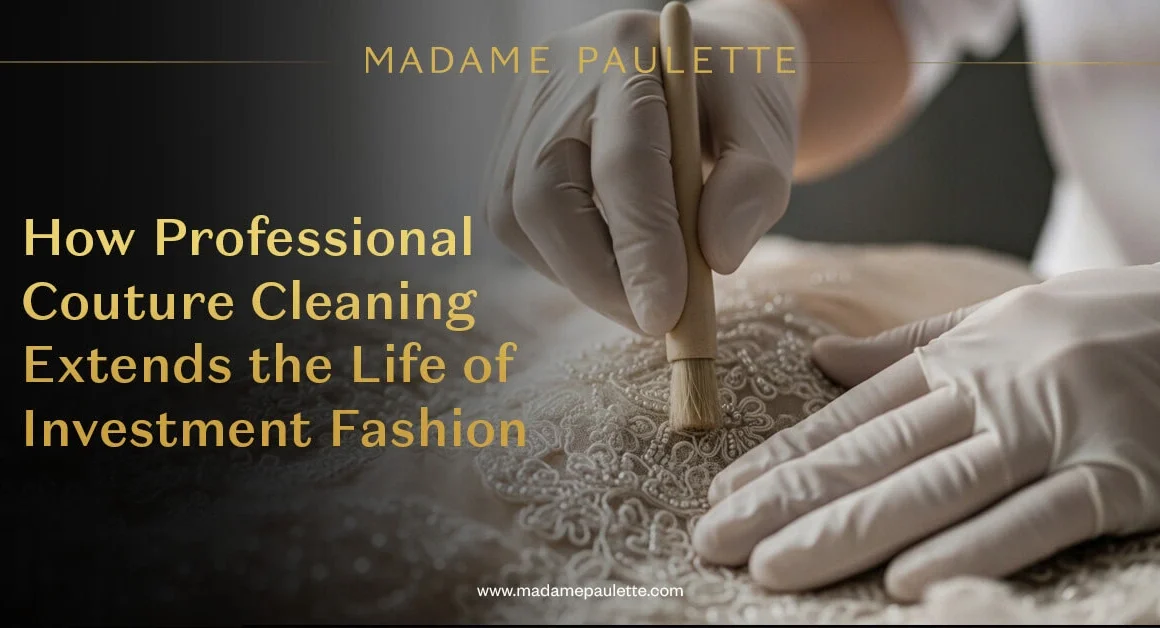
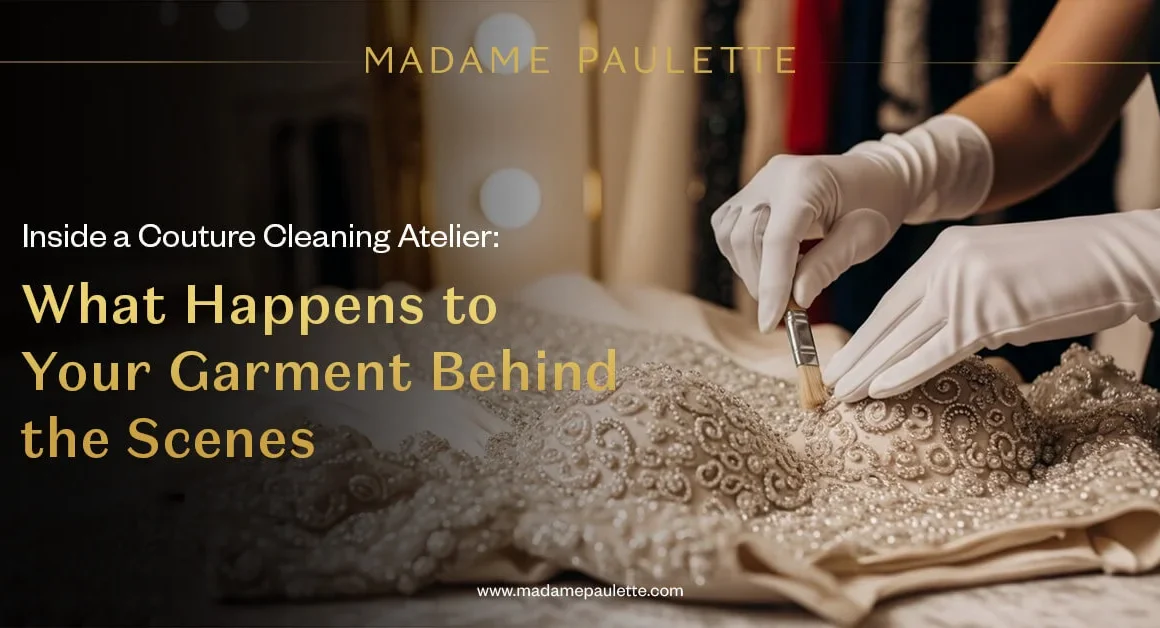
Once the plan is set, the garment enters pre-treatment. This is a labor-intensive stage where delicate dress cleaning truly begins. Artisans use a variety of specialized brushes, some as soft as makeup brushes, to apply proprietary spotting agents to soiled areas. This is done on a “cold tension” table that uses vacuum suction to draw the stain out of the fabric without spreading it.
If a garment has complex buttons or removable fur trim, these are carefully detached and labeled. If they cannot be removed, they are encased in protective “foil wraps” or custom-made fabric shields. This prevents the buttons from cracking or the metal hardware from tarnishing the surrounding fabric. This meticulous preparation is what separates a world-class couture cleaning atelier from a standard service.
Hand Cleaning and Dry Cleaning Techniques
The actual cleaning phase is where specialized dry cleaning technology shines. For garments that are too fragile for any mechanical action, hand immersion is the only option. The garment is placed in a silk bag and gently agitated by hand in a bath of pure, distilled solvent. This solvent is filtered constantly to ensure no impurities are redeposited onto the fabric.
For items that can withstand the machine, the atelier uses state-of-the-art “System K4” or silicone-based solvents. These are eco-friendly, biodegradable, and chemically inert, making them perfect for designer garment cleaning. Unlike traditional PERC, these solvents do not have a harsh odor and do not strip the natural luster from fibers like cashmere or wool. The temperature and cycle length are micro-managed to prevent any “thermal shock” to the garment, which is a vital part of luxury clothing care.
Pressing, Shaping, and Finishing
After cleaning, the garment often looks “flat.” The finishing stage is where the magic happens. Master finishers use “hand-form” steaming to rebuild the piece’s three-dimensional shape. They don’t use heavy industrial presses that can leave “shine marks” or crush the velvet pile. Instead, they use specialized irons with Teflon shoes and soft steam pillows.
This phase is essential for professional clothing restoration. For example, a jacket with a structured shoulder must be steamed from the inside out to maintain its architectural silhouette. If a gown has a heavy train, it is finished on a long, padded table to prevent dragging. The goal is to return the garment to its “runway” state, ensuring the drape and movement are exactly as the designer intended.
Preservation Beyond Cleaning: Storage and Maintenance
Once the garment is pristine, the focus shifts to long-term survival. Most damage to couture actually happens during the months it sits in a closet, not while it is being worn.
Proper Storage Techniques
Standard hangers are the enemy of fine clothing. They create “shoulder nipples” and can stretch the seams of heavy garments. A couture cleaning atelier will always recommend padded, archival-grade hangers. For dresses with heavy beadwork, hanging is often discouraged entirely because the weight of the embellishments can pull the fabric apart. These should be stored flat in acid-free, pH-neutral boxes lined with unbuffered tissue paper.
Never store luxury items in plastic bags provided by a standard dry cleaner for couture. These bags emit gases that can yellow white fabrics and trap moisture, leading to mildew. Instead, use breathable cotton or muslin covers. These covers shield the garment from light and dust while allowing the fibers to “breathe.” This is a fundamental rule of premium fabric preservation.
Regular Inspections And Care Tips
Even if a garment is not being worn, it should be aired out annually. This allows you to check for “protein-eating” pests such as clothes moths and carpet beetles. Keeping your closet climate-controlled is also key to preserving delicate couture fabrics. High humidity can lead to mold, while extreme dryness can make fibers like silk and leather brittle.
If you spill something on a couture piece, never rub it with a wet napkin. This can “break” the fibers, creating a permanent white mark. Instead, blot the area gently and take it to a couture cleaning atelier as soon as possible. The longer a stain sits, the more it chemically bonds with the fabric, making delicate dress cleaning much more difficult.
Why Choose a Couture Cleaning Atelier Like Madame Paulette
The risks of improper care are simply too high for luxury fashion. Madame Paulette has earned its title as the world’s leading dry cleaner for couture by consistently delivering results that seem impossible. We have restored gowns recovered from floods and removed red wine from white bridal silk. Our facility is designed to handle the logistical and technical challenges that other cleaners avoid.
Choosing a couture cleaning atelier means you are opting for a “concierge” experience. We offer detailed tracking, expert consultations, and even “on-site” emergency services for major fashion events. Our commitment to couture garment handling means we treat a $50,000 gown with the same precision as a museum artifact. By choosing an authority figure like Madame Paulette, you ensure that your fashion legacy remains untarnished.

FAQs – Couture Cleaning
How often should couture garments be professionally cleaned?
Luxury garments should be cleaned after every use to prevent body oils and perspiration from weakening the fibers. Even if a stain isn’t visible, these organic compounds can cause long-term yellowing and attract pests.
Can couture garments be cleaned at home safely?
Attempting to clean haute couture at home is extremely dangerous due to its complex construction and the risk of water spotting. Only a professional environment can provide the controlled solvents and hand-finishing tools required for safety.
How is restoration handled for damaged luxury garments?
Restoration involves a collaborative effort between textile chemists and master tailors to repair physical damage and chemical degradation. This process of professional clothing restoration includes re-weaving fabric, replacing antique trim, and stabilizing aging fibers.
The Value of Expert Care
A couture cleaning atelier provides a vital service that allows these works of art to endure through time. Without the specialized knowledge of fabric chemistry and the patience of hand-finishing, the most beautiful garments in the world would quickly fade into ruin. Standard cleaning methods are inadequate for the demands of the modern luxury wardrobe.
By utilizing the services of an institution like Madame Paulette, fashion enthusiasts can rest easy knowing their pieces are receiving the best care available. Our dedication to professional couture cleaning has made them an indispensable part of the fashion ecosystem.
Investing in a couture cleaning atelier is not just about maintenance; it is about honoring the designer’s artistry and the wearer’s beauty. High-end fashion is a passion, and that passion deserves the protection of the world’s finest experts.